AR040925_0010
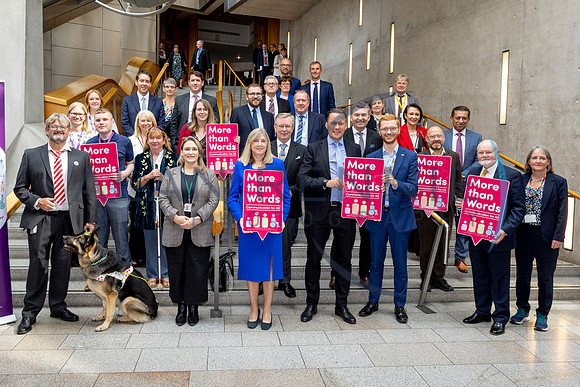
“More than Words: Communication for All” campaign.
PRESS RELEASE
CONTACT: Dr Hannah Tweed, 07894523065
AVAILABLE FOR INTERVIEW ON THURS 4th SEPT:
Dr Hannah Tweed, Manager, Scottish Sensory Hub, the Health and Social Care Alliance Scotland (1) – leading the More than Words campaign.
Issy McGrath, Chair of Deafblind Scotland and long-time campaign for the rights of Deafblind people. Issy lives with Usher Syndrome. She was born severely Deaf and her vision started reducing later in life - she is now completely blind. She faced barriers in learning Braille and accessing Tactile British Sign Language to help make the transition from a single sensory loss to dual sensory loss easier to manage.
Elaine Henson, Guide for Issy McGrath. Elaine supports people who are Deafblind, ensuring inclusive communication is key within all aspects of her work. Without inclusive communication, people with Deafblindness cannot access information, express themselves, or participate fully in society.
John Whitfield is 67 and from Angus. He has been Deaf from birth and Deafblind for 50 years. He's faced communication barriers all his life. He will bring his assistance dog.
Lauren Gilmour, Deaf Awareness Advisor at Forth Valley Sensory Centre and Director of Little Signs Ltd. Lauren's son was identified as Deaf at birth. There was no support for learning alternative forms of communication, only speech. Lauren has had to spend tens of thousands of pounds to communicate with her son so that he can express himself.
Toni McDermott began losing her hearing when studying as a mature student at college. There was often no access to subtitles/captions which often made achieving her degree feel impossible. Toni continues to experience barriers to accessing services where she is expected to communicate by phone with no alternative form of communication available.
Put the pieces together – campaigners call for legal change on equal communication, backed by hundreds of signatories
Scotland is failing those with extra communication needs – and over 200 organisations and individuals will today (Thursday 4 September 2025) take their case for legal change to the heart of government.
Signatories from organisations representing people with communication support needs – and individuals who have struggled – will be at the Scottish Parliament to say inclusive communication isn't a luxury, but a gateway to human rights.
Everyone should have a right to communication in a form they understand – to access health and social care when they need it, attend education or work, and participate in society.
Yet research earlier this year from the Health and Social Care Alliance Scotland (the ALLIANCE), highlighted that public bodies across Scotland provide a postcode lottery of support for people, and often do not track requests for help or provide training for staff. (2)
That’s why the ALLIANCE launched its More than Words campaign. Many national organisations back the campaign to ensure people aren’t left behind because society doesn’t accommodate their needs. This includes This includes Deafblind Scotland, RNIB, NDCS, RNID, the Scottish Assembly, Quarriers, Scottish Independent Advocacy Alliance, Values into Action Scotland, SUSE, Sign Language Interactions, Little Signs Ltd., Passion4Social CIC, and Forth Valley Sensory Centre. (3)
The campaign is also backed by individuals who are Deaf, Deafblind, have visual impairments, or have learning difficulties, among others – many of whom will be at Scottish Parliament to call for change.
The ALLIANCE and campaign supporters are asking the Scottish Government and Scottish Parliament to put together the pieces – represented by a large jigsaw – and ensure public recognition that equal communication is a right, legislation to protect those rights, better training and data collection, and monitoring.
Dr Hannah Tweed, who led the research and campaign for the ALLIANCE, said: “Most of us will need communication support at some point in our lifetimes. However, because there is a lack of good support, people often encounter problems. We’ve heard countless stories of people unable to access health and social care when they need it, attend education or work, and participate in society.
“Communication for all means sharing information in a way that everybody can understand. It includes all forms of communication – written, online, phone calls, and face to face. Inclusive communication is a gateway to accessing all our human rights.”
Although both the Equality Act 2010 and the BSL (Scotland) Act 2015 offer useful protections, currently people in Scotland do not have a clear legal right to inclusive communication. This leads to a postcode lottery when it comes to communication support, and significant inequalities for people.
“That’s why we need equal rights to communication enshrined in law, and that right become second nature to public bodies, whether it’s staff training or support services front and centre. Without strong legal protection for people’s right to inclusive communication, Scotland is unlikely to see systemic change,” added Dr Tweed.
The ALLIANCE is the national third sector membership organisation for the health and social care sector, representing over 3,500 members.
/ends
Notes to editors
The Health and Social Care Alliance Scotland (the ALLIANCE) is the national third sector membership organisation for the health and social care sector. We bring together over 3,500 people and organisations dedicated to achieving our vision of a Scotland where everyone has a strong voice and enjoys the right to live well, with dignity and respect. Our members are essential in creating a society in which we can all thrive, and we believe that by working together our voice is stronger.
Using Freedom of Information requests and interviews, the ALLIANCE Scottish Sensory Hub researched the current provision and understanding of inclusive communication across a range of public bodies in Scotland. Our analysis focuses on public bodies’ data collection practices, provision of inclusive communication support, complaints about support, and staff training. Findings showed:
Most Scottish public bodies (63%) do not track if or how they provide communication support.
Most Scottish public bodies (57%) do not track how many communication support requests are made to them.
Most public bodies (64%) offer some form of inclusive communication training. However, training content is variable and often doesn’t cover the needs of whole groups of people (e.g. Deaf people, people with learning disabilities, etc.).
Where data is collected on training uptake, most staff don’t complete the offered inclusive communication training. Training uptake is often only 1-2% of employees. Without proper training, it’s difficult for people to support communication for all.
Signatories who have given permission for their names to be publicised are as follows:
Sara Redmond, the Health and Social Care Alliance Scotland (the ALLIANCE)
Laura Jones, Royal National Institute of Blind People (RNIB) Scotland
Isabella Goldie, Deafblind Scotland
Ruth MacLeod, Royal National Institute for Deaf People (RNID)
Jacquie Winning MBE, Forth Valley Sensory Centre (FVSC)
Sonya Bewsher, The Scottish Assembly
Mona Vaghefian, National Deaf Children’s Society (NDCS)
Suzanne Finnigan, Hayfield Support Services with Deaf People
Kirsty Brennan, Glasgow Council for the Voluntary Sector (GCVS)
Lauren Gilmour, Little Signs Ltd.
Breda Leyne, ESquared
Derek Todd, Lanarkshire Deaf Hub
Beth Brownlee, West Lothian College
Lesley McCranor, Healthy Valleys
Vanessa Paynton, Art in Healthcare
Neill Clark, East Ayrshire Advocacy Services
Kimberley Swan, Family Advice and Information Resource (FAIR)
Kaz Becker, Passion4Social CIC
Donna-Marie Speir, Values Into Action Scotland (VIAS)
David Cameron, Scottish Union of Supported Employment (SUSE)
Sheila Mackay, Centre for Inclusive Living Perth and Kinross
Matthew King, Sign Language Interactions (SLI)
Craig Anderson, Stirling District Citizens Advice Bureau Ltd.
Beth Davidson, Feeling Strong
Ewan Carmichael, Quarriers
Rhona Willder, Scottish Independent Advocacy Alliance (SIAA)
Fiona Clarke, Autistic Mutual Aid Society Edinburgh
Allison Smith, Independent Living Fund (ILF) Scotland
Amanda Purdie, Amma Birth Companions
Tina Harper, Good Shepherd Centre Education
Theresa Casey, Choose Play, East Lothian Play Association
Cllr Roland Proctor
Cllr Marie Boulton
Cllr Hannah Powell
Cllr Robin Tatler
Cllr John Paton Day
Cllr Claire Miller
Cllr Janis McDonald
Dr Hannah Tweed
Suzi Beaton
Ian Carmichael
Helen Robertson
Anne Garry
Marianne Kelly
Chris Walters
Marie McGinn
Ann Thallon
Ann Muir
Karen McCulloch
Ian Johnstone
Peter Rieu-Clarke
Leah Cronin
Manjeet Cross
Susan Davie
Kyle Bettley
Kirstie Henderson
Alice Sharp
Susan Fullerton
Marie Petrie
Dr Dagny Gasking
Isabel Clough
John Whitfield
Valerie Houghton
Derek Kelter
Ian Jubb
Linda Long
Maya Lawie
Holli Sharifi
Martina Proctor
Heather Roy
Yasmeen Shah
Patricia Petrie
Richard Brodie
Martina Proctor
Louise Rogers
Dana Horsburgh
Ruth Buchanan
Rob Gowans
Alison Philipps
Elizabeth McLaughlin
Sam Braid
Christine Mulligan
Pamela Kay
Dot Smith
Susan Thomson-White
Pauline McKay
William Mclaughlin
Nicola Carstairs
Heather Jamieson
Julie McGrory
Karen Man